WW2 HistoryBook World War II historical images. WW2 book reviews and movie reviews.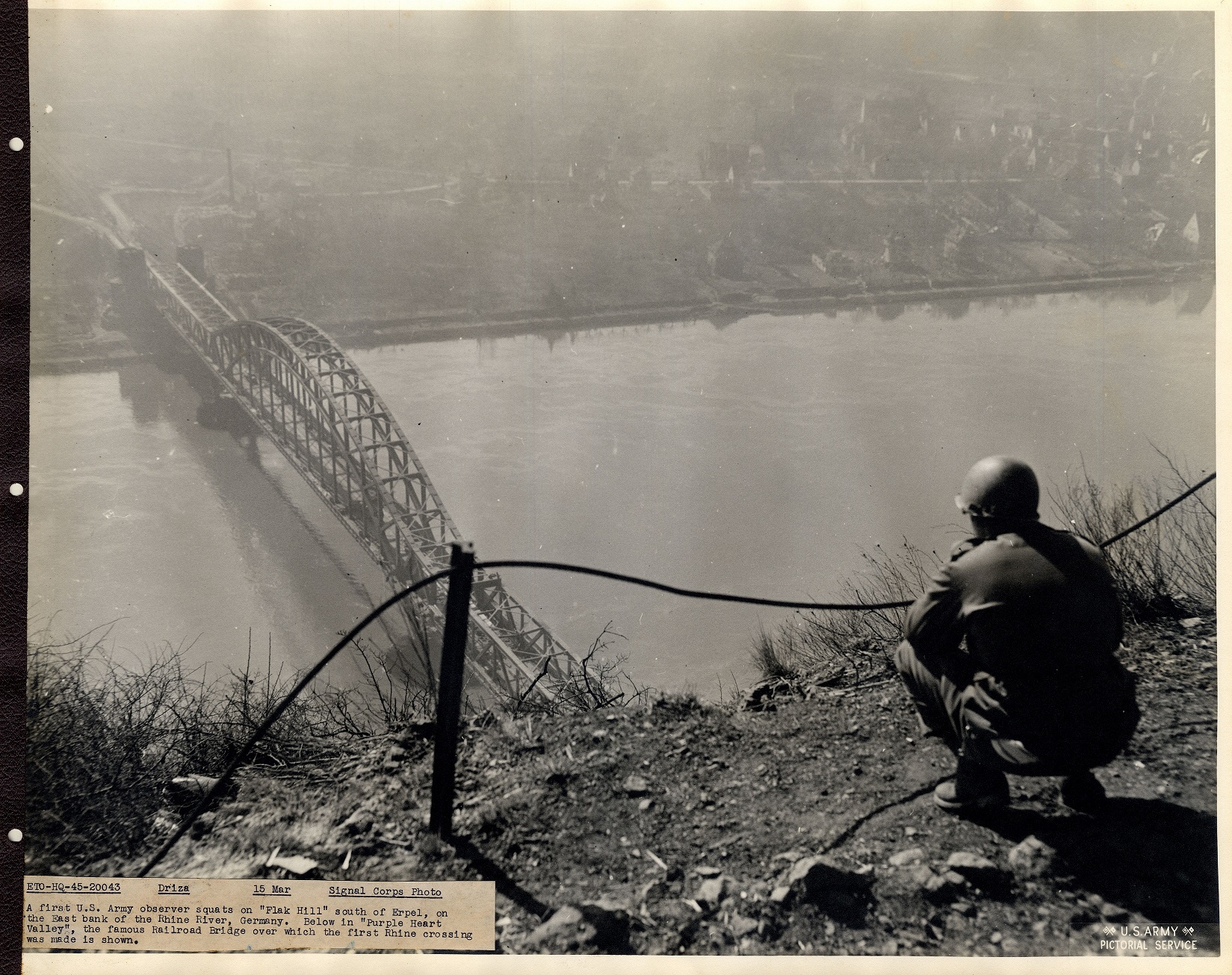
A view of the Ludendorff Bridge from the top of Erpeler Ley Hill on March 9th, 1945. Eight days later, its collapse took the lives of 28 U.S. Army engineers and injured 63 more.
Erpeler Ley was nicknamed “Flak Hill” by Allied soldiers due to the concentration of German anti-aircraft defenses positioned there.
The photograph features Dan Feltner of Company C, 656 Tank Destroyer Battalion, overlooking the valley.
The famous Ludendorff Bridge was built during World War One at Remagen, Germany. Its purpose was to facilitate German movements over the Rhine river.
In early March 1945, it was a critical bridge still left standing, as the Allies achieved a surprisingly quick advance towards the Rhine. They were surprised to see the bridge had not yet been demolished. The Germans tried to blow it up, but some of the explosives failed, and so U.S. troops were able to capture it unexpectedly.
The Germans continued their desperate attempts to demolish the bridge, employing everything they had at their disposal for this endeavour. This included new weapons and tactics, which were finally successful on March 17th. But the Allies had already managed to move divisions across the Rhine and had built improvised makeshift bridges over the river.
It is widely agreed among historians that the battle of Remagen significantly shortened the war in Europe.
Today, the Ludendorff Bridge towers are still standing in what is now a peaceful little riverside town, and there are plans to rebuild the entire structure.
Book suggestion ⤵️
📖 The Bridge at Remagen: A story of World War II (Ken Hechler, 1957)
Movie suggestions ⤵️
🎥 The Bridge at Remagen (1969)
🎥 A Bridge Too Far (1977) – This covers the 1944 Operation Market Garden, so it is not specifically about the Ludendorff Bridge. But it is a great movie and well worth a watch.
Photo source: U.S. Army Signal Corps, National Archives