WW2 HistoryBook World War II historical images. WW2 book reviews and movie reviews.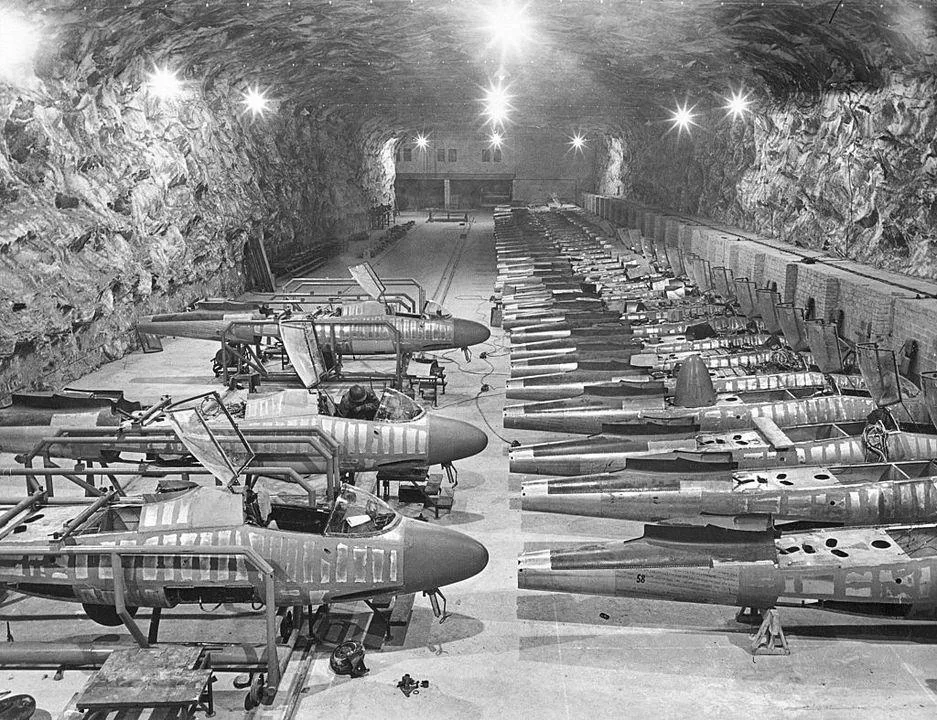
Underground aircraft factory at the salt mine in Tarthun, Germany. Certain sources locate the image somewhere in Austria, but that is false. It was in fact taken, as mentioned, at the Tarthun salt mine in Saxony-Anhalt.
The photograph was captured on April 15th 1945 by advancing US troops, who were surprised to find this assembly line 300 meters beneath the earth. The factory was operating for several months and had an output of 40 to 50 planes per month. A large elevator brought the aircrafts to the surface.
Towards the end of the war Germany built multiple underground construction plants in order to protect aircraft production from Allied bombing. Most of these factories used labor from concentration camp prisoners. Examples include the Mittelwerk facility, the Walpersberg/Kahla complex, and the Weingut 1 bunker.
This particular salt mine was used for the production of the single-engine Heinkel He 162 “Volksjäger” (“the people’s fighter”). This aircraft was primarily made out of wood materials and could be constructed very quickly. It was also easy to repair and maintain. The He 162 had won a design competition to create a cheap, lightweight and high speed fighter which could be mass produced with minimal resources as Germany was facing massive shortages towards the end of the war.
However, due to a series of accidents in testing, the introduction of the Heinkel He 162 in the Luftwaffe kept being postponed. As such, the aircraft only became operational in the early part of 1945, when Germany was already facing inevitable defeat. Out of 1000 Heinkel He 162’s on the production lines, only 120 were sent to the Luftwaffe. Due to the late date of delivery, most of them never saw combat. Reports say the Volksjager’s first mission was on April 19th 1945, by which time the Red Army was circling Berlin. For context, Adolf Hitler’s last visit outside the Fuhrerbunker was on April 20th.
The aircraft proved to be very dangerous to maneuver. It also had issues due to low fuel capacity and still had some structural failures, but in the hands of experienced pilots it could be a first-rate weapon. This was confirmed by British Royal Navy officer and test pilot Eric Brown after flying one of these specimens after the war.
Book suggestions ⤵️
📖 The Hated Volksjäger: Histories of the Heinkel He 162 (Dan Sharp, 2015)
📖 The End: Hitler’s Germany, 1944–45 (Ian Kershaw, 2011)